
Florida’s scenic rural highways are known for their beauty—they soon will also be known for their safety in preventing lane departure crashes. In a bold move to enhance roadway safety without sacrificing community comfort, the Florida Department of Transportation (FDOT) has implemented a new standard in road design: ground-in sinusoidal audible and vibratory treatments (AVTs). This innovative, quieter version of traditional rumble strips is being installed on high-speed, two-lane rural roadways as part of a $60 million statewide initiative.
“Florida has an aggressive target of zero fatalities and serious injuries, because when it comes to human lives, no other number is acceptable,” said Brenda Young, FDOT safety engineer. “To reach this target, we identified our top challenges and made strategic investments that will result in the greatest impact.”
Set for completion in 2025, the installation follows a comprehensive analysis of Florida’s most dangerous roadway segments and directly addresses public concerns—especially those raised by residents and bicyclists—about the noise and accessibility issues posed by traditional rumble strips.

Rumble strips are designed to alert drivers through vibration and sound when a vehicle veers from its lane, helping prevent run-off-road crashes. However, as lifesaving as they may be, their harsh noise has disrupted nearby communities and created challenges for cyclists. Recognizing the need for a better balance between safety and livability, FDOT partnered with the Center for Urban Transportation Research (CUTR) at the University of South Florida (USF) to evaluate alternative designs. Their research identified the optimal solution: Type 2 sinusoidal rumbles, a quieter and equally effective safety countermeasure.
“The research and partnerships established through this effort have inspired our team to implement supporting criteria and standard plans which create a cost-effective lane departure countermeasure,” said Derwood C. Sheppard, Jr., M.Eng., P.E., project manager and design engineer at FDOT. “The result of which was the State Roadway Design Office’s implementation of ground-in sinusoidal rumble strips as the new standard AVT for all asphalt pavements.”
The Motivation
Roadway departure (RwD) crashes remain one of the most persistent and deadly traffic safety issues in Florida. Between 2015 and 2019, these crashes accounted for 34 percent of all traffic incidents and a staggering 42 percent of statewide fatalities, with a disproportionate number occurring on rural two-lane roadways. These statistics made it clear: tackling RwDs had to be a top priority in Florida’s mission to reach zero fatalities.
As FDOT explored solutions, sinusoidal rumble strips, with their quieter acoustic profile, emerged in national literature as a promising alternative to traditional AVTs. Yet, despite growing interest, there was little conclusive data on their real-world safety performance. The need to balance safety with livability presented both a challenge and an opportunity.

Recognizing this, the FDOT research team—led by Dr. Pei-Sung Lin, Director of the Traffic Operations and Safety Program at the Center for Urban Transportation Research (CUTR)—set out to answer a critical question: Could sinusoidal AVTs both reduce roadway noise and save lives?
“Because we interviewed the four to five states that had implemented them, we knew the noise reduction feature would be effective for our goal to meet the noise concerns of nearby residents,” said Lin. “But we also knew, in Florida, more people are killed in RwD crashes than all other crash types. So that was our motivation: can sinusoidal AVTs reduce noise and fatality and serious injury crashes?”
The Research
To ensure that the new AVT standard would deliver both safety and community benefits, FDOT launched an in-depth research project to evaluate the effectiveness of three ground-in AVT designs on arterials and collectors. The study focused on three key criteria: noise reduction, driver alertness, and crash prevention.
After an extensive literature review and interviews with transportation agencies in leading “champion states” already using sinusoidal rumble strips, the FDOT team—working alongside the Center for Urban Transportation Research (CUTR)—conducted field-based focus group noise studies at 12 locations along State Road 100 in Putnam County and U.S. Highway 301 in Clay County. Each site featured six 1,200-foot test sections per direction, where test vehicles drove at both the posted speed limit and 5 mph above it. The FDOT State Materials Office carried out complementary tests to assess noise impacts from both shoulder and edge-line rumble strips.
Beyond noise testing, the team gathered detailed roadway and traffic data and performed a before-and-after safety evaluation, incorporating Crash Modification Factors (CMFs) specifically developed during this project. CMFs are essential tools used by transportation engineers to estimate how a safety countermeasure—like AVTs—will affect crash frequency at a given site.
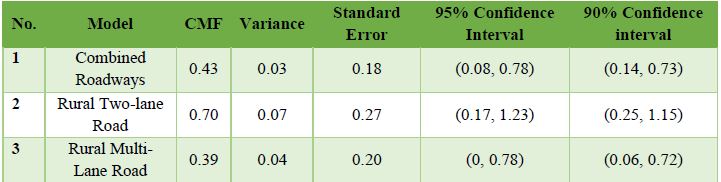
“The evaluation showed the CMFs for all three designs were lower than 1.0, meaning the application of the sinusoidal AVT can reduce RwD crashes,” said Dr. Pei-Sung Lin, principal investigator and Traffic Operations and Safety Program Director at CUTR. “The results showed significant impact on rural two-lane and multi-lane roadways.”
The data confirmed the life-saving potential of sinusoidal AVTs:
- 57% overall reduction in roadway departure crashes (CMF = 0.43)
- 30% reduction on rural two-lane roadways (CMF = 0.70)
- 61% reduction on rural multi-lane roadways (CMF = 0.39)
- 62% reduction in fatal and serious injury crashes across all studied road types (CMF = 0.38)
“This reduction in serious injury and fatal crashes, when paired with noise level considerations, led to the recommendation for Type 2,” Lin added. “Type 2 alerts the driver—but it doesn’t disturb the community—and it delivers real safety benefits.”
Implementation & beyond
To ensure the greatest impact from its investment, the FDOT State Safety Office undertook a comprehensive, data-driven analysis of Florida’s roadway system. The goal: pinpoint the common characteristics associated with fatal and serious injury lane departure crashes and identify where those risk factors were most prevalent. This systemic screening of both on- and off-state roads enabled FDOT to zero in on the 3,085 centerline miles of high-speed rural roadways with flush paved shoulders most in need of treatment.

“This data-driven and risk-based approach prevents lane departure crashes before they occur by anticipating and mitigating human error with a low-cost, high-benefit solution strategically installed in locations where those errors would likely result in fatal or severe crashes,” said Brenda Young, FDOT safety engineer.
At an estimated cost of $18,000 per centerline mile, the implementation of Type 2 sinusoidal AVTs offers an exceptional return on investment—projected to save 150 lives or more each year. Recognizing the importance of accommodating all road users, the project also incorporates bicyclist-friendly features, including a minimum 4-foot buffer between the rumble strip and pavement edge, along with 12-foot gaps every 60 feet to allow for safe entry and exit.
“We’re pleased to recognize this significant effort to save lives in Florida,” Young added.
While the research was conducted at 12 dedicated implementation sites, all seven FDOT districts have since initiated bundled projects to expand the use of sinusoidal AVTs statewide. According to Dr. Pei-Sung Lin, this momentum signals a pivotal shift not only for Florida, but for other Departments of Transportation seeking to improve roadway safety without compromising community quality of life.
“It gives us an opportunity to collect crash data and to learn more about the design,” he said. “Ultimately, the reality is when you implement something without considering everyone’s input, you could be prevented from implementing more, which could diminish safety on our roads.”
“But here, we have clearly demonstrated the safety benefits of reducing fatal and serious injury crashes in addition to noise reduction,” Lin added. “We hope to see a reduction in roadway departures in Florida, especially on rural two-lane roadways, because this is how we can really save lives.”
Further reading
BED25-977-03 Evaluation on Effectiveness of Audible and Vibratory Treatment Installations on Arterials and Collectors Based on FDOT Context-based Design Criteria Final Report | Summary
 Florida Department of Transportation Research Showcase