
Imagine your workplace situated just a few feet away from oncoming traffic.
This challenging situation is a daily reality for roadway construction workers, crash responders, and various transportation professionals who carry out their duties within work zones. Unfortunately, the proximity of work zones to traffic can pose severe risks, potentially leading to tragic consequences.
In Florida, most of these fatalities happened on arterial roads, accounting for 55% of all work zone-related fatal crashes in Florida from 2012–2019. Past research has focused on interstates because of the high speeds, but Florida has more arterial work zone fatal crashes than those on freeways and interstates. Research in Florida was needed to improve arterial work zone safety.
Safer work zones save lives. Fortunately, many technologies promise to make them safer, and many more are being developed.
Evaluating Smart Work Zone (SWZ) Effectiveness
The Florida Department of Transportation (FDOT) contracted the Center for Urban Transportation Research (CUTR) at the University of South Florida (USF) to research and apply SWZ concepts on arterial roadways to find out how well they work. This research was also supported by the Florida Work Zone Safety Coalition, which is partly backed by the construction industry, which has a direct interest in maintaining the safety of crews. FDOT District 7 led and managed this innovative arterial work zone safety project.
“The significance of this research is that it quantified the safety benefits of smart work zone technologies in real world work zone and traffic conditions,” said Dr. Edith Wong, the project manager for the research project, “Prioritized Safety Consideration by Work Zone Types and Pilot Implementation (BDV25-977-66).” “The findings provide a basis for further investment, development, and deployment of the technologies to improve work zone safety.”

The CUTR research team investigated the impact of SWZ applications on vehicle speeds and driver behaviors at seven construction sites, including arterial roads in urban and rural areas. The study sites cover three typical work zone types (lane shift, work on median/shoulder, and lane closure). This research placed significant emphasis on evaluating the effectiveness of active work zone awareness device (AWAD) deployment and its combination with law enforcement (LE) presence, connected vehicle (CV) technologies that work with vehicle navigation systems, and other applications.
Why AWADs?
The deployment of AWADs could be a low-cost, effective, and innovative solution to improve arterial work zone safety. AWADs incorporate radar combined with flashing Light-Emitting Diode (LED) signs that (1) warn drivers of an upcoming active work zone with the presence of workers, (2) display drivers’ approaching speeds, and (3) warn drivers of “speeding fines doubled” (See Figure 1).
“Traditionally, we just post a sign that says ‘speeding fines doubled’ even though there are no workers there at times – which is why many drivers stopped following it. That becomes dangerous,” said Dr. Pei-Sung Lin, ITS, Traffic Operations and Safety Program Director at CUTR and the principal investigator for this project. “The beacons of an AWAD only flash when the work zone is active with the presence of workers. Similar to school zone operations, this allows drivers to pay attention and respect traffic control devices at work zones.”
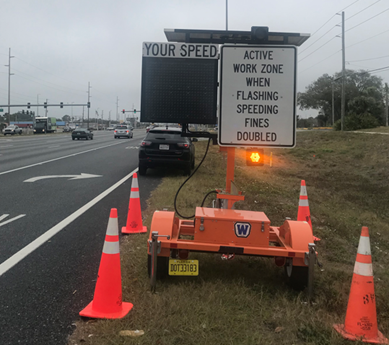
“Overall, we found that the deployments of AWAD and a combination of AWAD with law enforcement (LE) presence resulted in a good reduction in the speeds of vehicles approaching an arterial work zone, a significant increase in safe driver behaviors, and a decrease in risky driver behaviors,” he added.
The results of the SWZ treatments showed promise. For speed reduction, the presence of AWAD alone correlated with drivers decreasing speeds by 10% and up to 21%; AWAD and LE combined correlated to reductions at an average of 19% and up to 43%. For safe driving behavior—such as gradually decreasing speeds and smooth lane changes near upcoming lane closures—AWAD presence correlated with an average increase in these safe behaviors of 44%, and AWAD and LE combined for an average increase of 67%.
Finally, on risky driver behaviors—such as sharply decreasing speeds and abrupt lane changes near upcoming lane closures—AWAD presence alone correlated with an average decrease in this behavior of 43%. AWAD and LE combined saw an average decrease of 54%.
“I think for all of the research, the important part is that the proven countermeasures and treatments can be applied, and it means we’re ready to improve the real-world situation and make work zones safer for all road users and workers,” Lin said. He emphasized that it is important to integrate AWADs into work zone Maintenance of Traffic (MOT) plans to encourage widespread implementations of AWADs. The research showed that implementing AWADs with frequent LE presence can significantly improve arterial work zone safety.
As CV technologies continue to be expanded, the SWZ applications evaluated in this case study seem promising for improving safety for work zone crews and first responders. It is expected that in the near future, vehicle navigation systems will be able to gather from SWZ traffic control devices equipped with Road Side Unit (RSU) or cellular communications to accurately convey work zone conditions to motorists.
“Through this study, we proved that AWAD plus LE is very effective,” Lin said. “Instead of waiting for a crash to occur, using these approaches and technologies should be beneficial and practical to help reduce work zone related fatalities, injuries, and crashes.”
Implementation
This research project has expanded investigation into the use of intelligent transportation systems (ITS) for work zone safety. With the support of the findings of this project, FDOT Traffic Engineering and Operations at Central Office has also developed a framework that could be used for mainstreaming of smart work zone devices within FDOT construction projects. Other districts have developed their own pilot SWZ implementations. Notably, District 4 developed a program that identifies opportunities to include SWZ devices during the various phases of construction projects and, with the support of leadership, funding for the devices. District 5 has built a unique version of the AWAD trailer that includes improvements to the trailer’s communication capabilities to not only display information, but also to collect and communicate it to the traffic management center.
All these efforts together have greatly enabled the expansion of smart work zone devices within Florida statewide, increasing its impact in protecting both workers and road users.
Further Reading
BDV25-977-66 Prioritized Safety Consideration by Work Zone Types and Pilot Implementation Final Report | Summary
 Florida Department of Transportation Research Showcase