
A sense of freedom. The open road. Beautiful countryside. For those who love riding motorcycles, these benefits draw them especially to rural areas.
But that freedom comes with a risk.
“Motorcycle crash injury is like a hidden issue,” said Dr. Chanyoung Lee, program director of motorcycle injury prevention at the Center for Urban Transportation Research (CUTR) at the University of South Florida (USF) and a member of a Florida Department of Transportation (FDOT) research team that recently published a study on motorcycle safety. “In Florida, motorcycles represent about one percent of traffic but makeup about 17 percent of the traffic fatalities in the past five years (2018-2022).”
According to the National Highway Traffic Safety Administration (NHTSA), motorcyclists in the U.S. are 30 times more likely than car passengers to be fatally injured in traffic crashes. On Florida roadways, 57 percent of fatal and 36 percent of incapacitating single-motorcycle crashes occur on curved roads.
It is on this road type – rural, two-lane road with curves – researchers with CUTR and FDOT tested safety interventions aimed at preventing single-motorcycle crashes.
“A common scenario of a single-motorcycle crash in Florida is that the rider loses control of the motorcycle and then runs off the curb or hits a tree (or another object),” Lee said. “In this type of crash, no other vehicles are involved, and it can be reduced if we can make the rider take more caution.”
Danger: Curve Ahead
The research team identified roughly 10,900 horizontal curves, including 2,592 rural two-lane curves for this study. They itemized the characteristics of those curves, including the type, radius, geometrics, pavement type, and traffic volume.
The team then conducted a field experiment across 18 horizontal curves on a 9.1-mile stretch of County Road 494 in Crystal River to measure two major behaviors – drivers’ speed and attention. The rural two-lane road was chosen for the field experiment because it is a popular destination for motorcycle enthusiasts in central Florida.
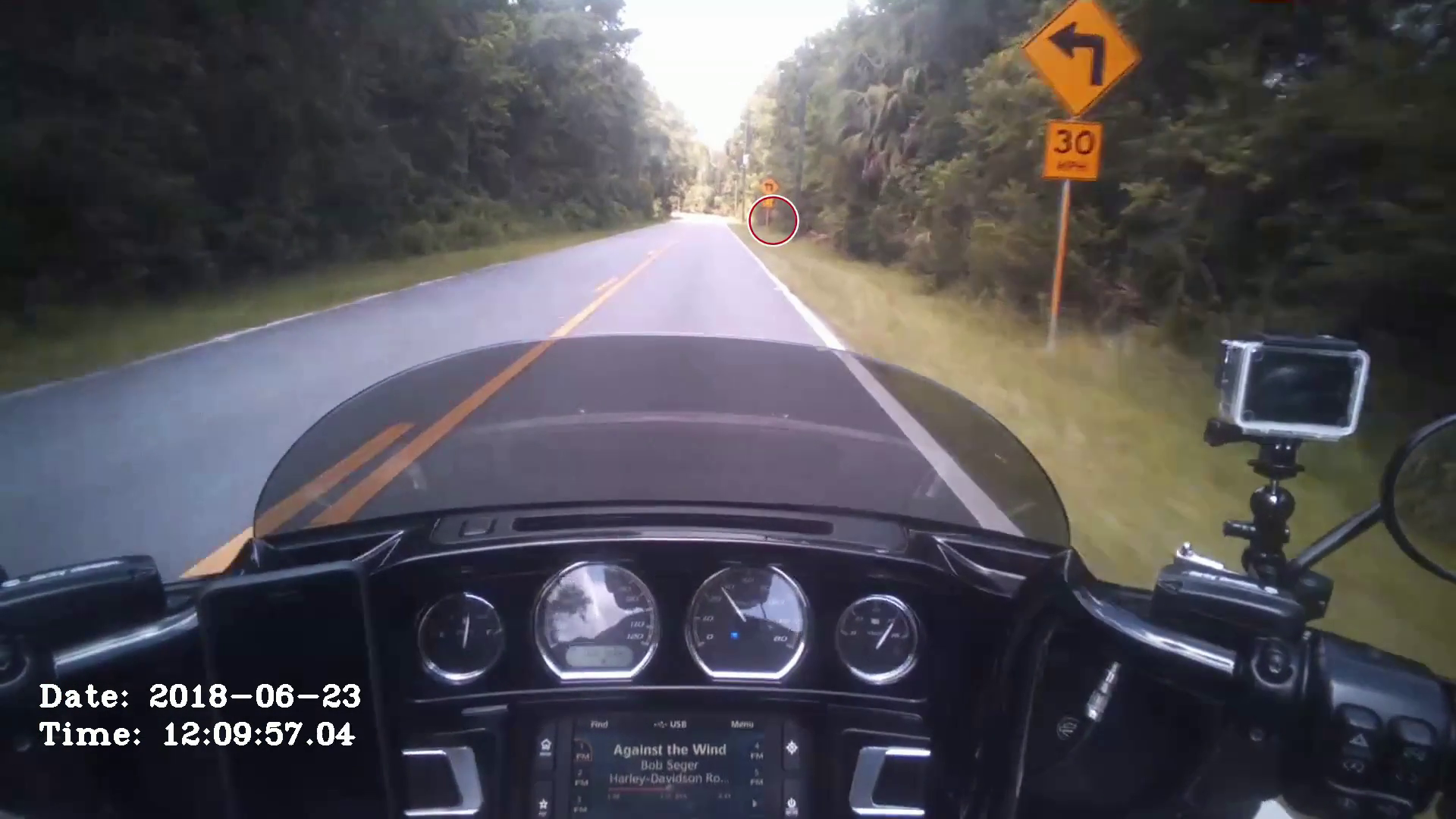
Eighteen speed feedback signs (SFS) were installed ahead of the curves.
“We measured the motorcycle speed when approaching a curve and we measured the attention of the motorcyclist by using an eye tracker to see how a rider scans the roadway when approaching a curve,” said Dr. Zhenyu Wang, principal investigator for the research project.
The team placed dynamic speed feedback signs (DSFS) on different settings (off mode, displaying the static speed, and flashing while displaying the dynamic speed) at curve locations. They found that motorcyclists struggled to identify the approaching curve and therefore continued to “take high speeds on rural curves,” especially on curves they were familiar with, Wang said.
A Sign of Motorcycle Safety
The presence of active DSFS significantly reduced motorcycle speed. Rates decreased at the beginning of the curve by 28.9 percent and at the sign by 17.6 percent. The dynamic mode also increased attention rates on the DSFS sign more than the other static or off modes.
Essentially, the researchers found that sign placement relative to the curve was important and the presence of an activated sign effectively increased driver attention while riding through the curve, indicating a positive safety effect.
“We can confirm that this dynamic feedback sign has a positive impact on motorcyclists’ behavior, particularly in relation to two major behaviors: speed and attention,” Wang said.
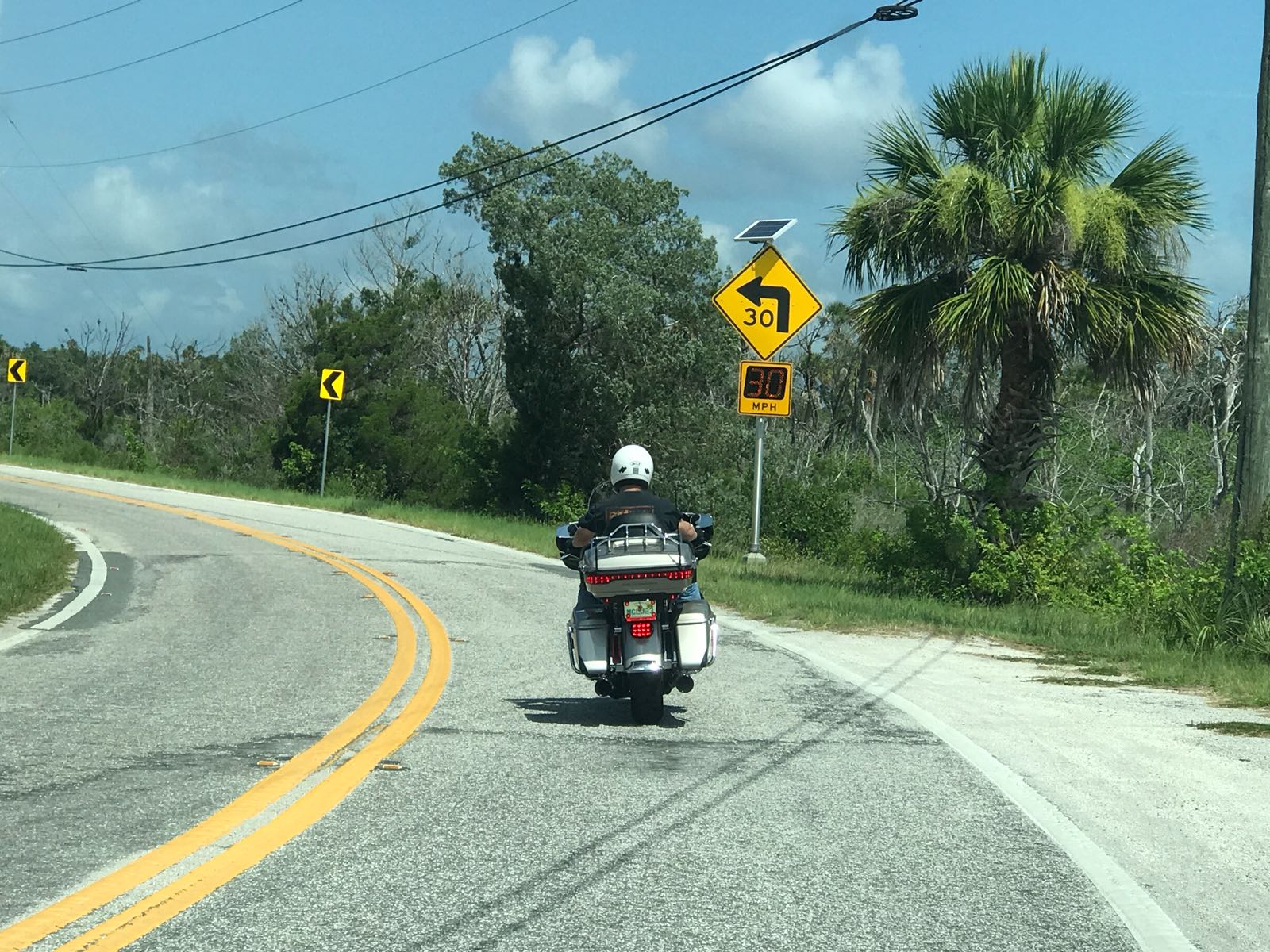
Lee noted that the DSFS did have limitations and other treatments, like curve radius and pavement treatments, should be investigated.
“The Dynamic Speed Feedback Sign is a proven safety countermeasure according to FHWA, and it has been widely adopted in many states. However, this was the first study to focus on motorcycles. In what we found, many flashing signs are not detecting motorcycles in a timely manner,” Lee said, noting that, for the sake of the study, the team increased the sensitivity of the DSFS to better detect the approaching motorcycles. “By the time the signs detect the motorcycle, it’s almost too late for the rider to react to the sign.”
While the findings were significant, the researchers also recommend multi-faceted approaches to reducing motorcycle speeds, such as educational courses aimed at increasing motorcyclists’ risk awareness and negotiation skills.
Further Reading
Study on Motorcycle Safety in Negotiation with Horizontal Curves in Florida and Development of Crash Modification Factors Final Report | Summary
 Florida Department of Transportation Research Showcase