
Twenty-five seconds.
That’s how long it takes for a train to arrive at a railroad crossing after the bells chime. While no driver wants to be caught on the tracks at any time, after making an incorrect turn, some have found themselves stuck in just that position during those perilous seconds.
“That 25 seconds is very short and very dangerous,” said Dr. Pei-Sung Lin, traffic operations and safety program director at the University of South Florida’s Center for Urban Transportation Research (CUTR). “That’s why it is important to visualize that and make sure vehicles do not stop on the railroad track.”
The Florida Department of Transportation (FDOT) recently sponsored a research project that focused on identifying safety countermeasures to help prevent incorrect turns at highway-rail grade crossings. Lin is on the CUTR team that conducted this research.
“The instances of crashes on railroad tracks are relatively small compared to other crash types, but whenever a driver turns the wrong way onto the track, and then the train and vehicle or pedestrian collide, it is generally very serious,” he said.
Despite the lack of data on surrounding vehicles making incorrect turns at crossings, Lin’s team developed a theory on a driving behavior that signals a driver’s inclination to turn onto the tracks.
Does Hesitation = Wrong Turns?
“We developed the hesitation rate,” Lin said. “A vehicle slows down at a right turning lane for two reasons: you’re in a slow-moving queue because of congestion leading up to the on-ramp or you slow down significantly because you’re thinking about whether you should make the turn.”
The hesitation rate is the number of vehicles turning at a crossing divided by the number of confirmed hesitation events, which happens when a vehicle decreases its speed drastically, like before making a turn. The more hesitation behaviors occurs, the higher the risk of an incorrect turn.
The railroad tracks this project investigated are in districts in South Florida. In these districts, drivers were making incorrect turns onto nearby railroad tracks while attempting to get onto the on-ramp to Interstate 95. These incorrect turns happened primarily because drivers were confused by directional sign placement, pavement markings, and GPS directions. Drivers also made incorrect turns to the left on the tracks to perform U-turns.
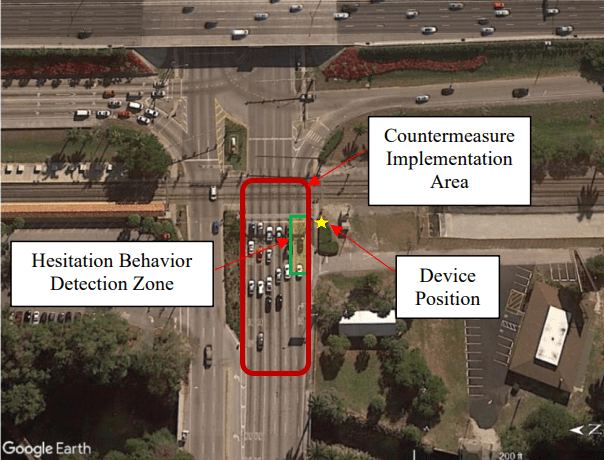
Depending on traffic, timing, and vision, all these scenarios could result in a train-vehicle collision. The research team evaluated countermeasures to prevent or minimize the impact of those factors.
Countering Wrong Turns
“To measure the hesitation rate of vehicles, we deployed countermeasures and conducted before and after analyses,” Lin said. “In the before analysis, when the vehicles slowed down a lot too early, it indicated they were anticipating where they should turn. In the after analysis, fewer vehicles had this hesitation, indicating the effectiveness of the countermeasures.”
The countermeasures were simple and cost effective.
The team removed any potentially misleading signage, such as the “right lane must turn right” sign placed before the railroad crossing; replaced potentially misleading right turn arrow pavement markings with straight arrows; and added guidance information like a state road name or interstate shield as pavement markings before the railroad crossings.
“This is a very simple solution,” Lin said, noting the recommended safety enhancements can be implemented in-house for agencies because they are cost-effective and relatively easy to install.
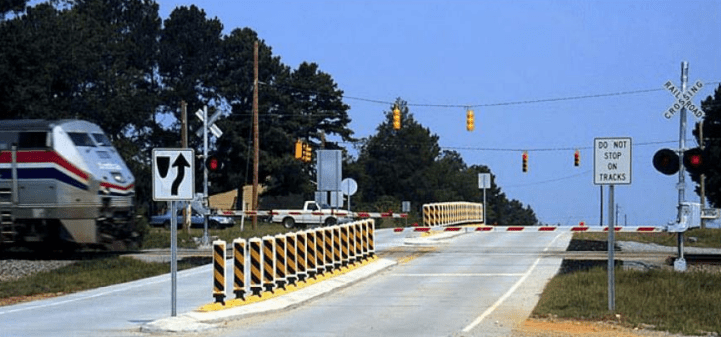
Regarding the roadways where drivers turn left to make a U-turn at railroad crossings, the team recommended installing Qwick Kurb delineators to prevent drivers from turning around. The posts narrow the turnaround space.
“Overall, after implementation, we showed a significant reduction in hesitation rates for drivers at at-grade crossings – 85 percent in the daytime and 97 percent at nighttime,” Lin said. “These are not very hi-tech countermeasures, but I think we’ve made a contribution.”
The project garnered a lot of attention. It received a regional supplemental research award from the American Association of State Highway and Transportation Officials’ High Value Research Projects program in 2022. Also, a paper based on a study from the project was published in the Institute of Transportation Engineers Journal and presented at the Transportation Research Board’s annual meeting in 2023.
Further reading
BDV25-977-54 2019 Pilot Implementation for Preventing Incorrect Turns at Highway-Rail Grade Crossings Final Report | Summary
 Florida Department of Transportation Research Showcase